
- Daily & Weekly newsletters
- Buy & download The Bulletin
- Comment on our articles
Related articles
Recent



Popular


'Gendarmerie 2.0': Belgium considers new national police force
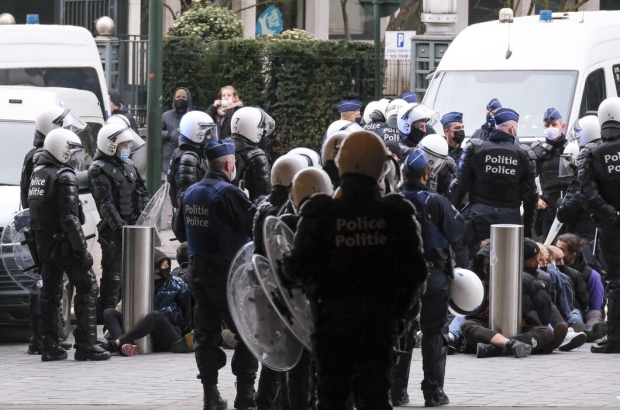
Belgium's defence and interior ministries are discussing the establishment of a new national mobile police brigade to deal with major public order incidents.
Defence minister Theo Francken (N-VA) described it as “a gendarmerie 2.0” and referred to the recent violence on the fringes of demonstrations as partial justification.
“When there are riots, it is necessary to step up security,” Francken told Flemish broadcaster VRT.
“Whereas in the past there was a gendarmerie on standby for serious riots or hooliganism, there is now still a federal reserve, but it’s more empty than full.
"We need an operational reserve with military training. When the violence is this extreme, we must be able to protect civilians."
Officers in the "gendarmerie 2.0" would be trained by the defence ministry and made available to the interior ministry.
According to Francken, prime minister Bart De Wever (N-VA) is aware of the plans and consultations were also confirmed by the office of interior minister Bernard Quintin (MR).
“Discussions have taken place, building on the already successful cooperation between the police and the defence ministry,” Quintin’s office said in a statement, referring, among other things, to the security of certain locations and joint patrols with the railway police.
“We are working together to see how we can strengthen that cooperation and the capabilities of our services to ensure the safety of citizens.”
Belgium used to have a gendarmerie, but it was abolished in the wake of the 1989 conviction of serial killer Marc Dutroux due a failure among various authorities to exchange information with each other, which was said to have allowed Dutroux to go undetected for so long.
When asked why bringing back a gendarmerie specifically might be necessary, Francken said “it is not currently possible to bring the problems fully under control”.
“The situation in some towns is extremely difficult, with very serious drug-related and gang-related violence,” Francken said, referring to a society that he said had been transformed by “mass migration”.
“This will not be a miracle solution. But it sends a clear signal to our law enforcement agencies that reinforcements are on the way.”
Quintin also expressed support for the measure, saying the new brigade is needed “to avoid ending up in a situation like the one in France”.
Brussels Mayor Philippe Close (PS) is opposed to the plans. “I need police officers,” he told RTL.
“They would do better to put more money into the police and the justice system than into this.”
Close is also demanding more places in the French Community’s youth detention centres.
“The police arrest most offenders and the judiciary does its job, but the government tells us there may be no places available until 2028. Let’s find a solution through house arrest, then,” Close said.
MP Ridouane Chahid (PS) also raised the fact that the N-VA party — to which the interior and defence minister belong — recently made cuts to the police budget.
Matti Vandemaele (Groen) likewise opposes a "gendarmerie 2.0", accusing Francken of “casting doubt on the competence of our police officers and once again playing the militarisation card”.
Far-right party Vlaams Belang is in favour of the plans, although it claims that Francken copied the idea from a campaign that the party recently ran following the killing of police officer Nordine El Talbi.
And while opposition party Anders is not opposed to the idea, MP Arthur Orlians described the problem of impunity primarily as an issue for the justice system.
“The police can arrest a thousand people, but if the justice system cannot subsequently prosecute them, you have solved nothing,” said Orlians.
“Existing laws must be enforced and a ban on attending demonstrations must be introduced for known troublemakers. Our bill has been tabled since 2023.
"Moreover, a structure already exists today in the form of the federal reserve and the intervention corps, which can be deployed."
Criticism was also levelled from experts such as criminologist and VUB professor Sofie De Kimpe, especially in regard to justifications tied to protest violence.
De Kimpe points out that even in the days of the gendarmerie, “many demonstrations got out of hand”, despite harsh repression.
“The gendarmerie often had nothing to do, but would then be ‘unleashed on demonstrations’, something that has frequently led to deaths and injuries throughout Belgian policing history,” De Kimpe told Bruzz, referring to the violence during the Cockerill strike in 1869, the Vietnam protest at the US embassy in 1968, the protests of the 1980s (when demonstrations sometimes resulted in hundreds of injuries) and numerous other examples.
De Kimpe said that while demonstrators today are indeed less inclined to negotiate with the police, a return to a militarised police force would be “adding fuel to the fire”.
“This will ultimately lead to more violence and only reinforce the spiral of violence. It’s short-sighted politics,” the criminologist said.
“Using more violence to combat violence is a typical reflex. But that also comes at the expense of social cohesion in society. All we see today is polarisation.”
One of multiple, better solutions, De Kimpe said, would be strengthening police training.
“What we separated from the army back then, they now want to bring back. Yet this was a deliberate choice,” she added.
Like MP Chahid, De Kimpe also pointed out that the government has repeatedly made cuts to police funding, resulting in a shortage of officers and especially officers with a community approach and an understanding of the neighbourhoods in which they patrol.