
- Daily & Weekly newsletters
- Buy & download The Bulletin
- Comment on our articles
Related articles
Recent




Popular



Mental health in Belgium: Suicide prevention and the cry for help from youngsters

Suicide is the leading cause of death among 10- to 54-year-olds in Belgium, yet there remains a taboo around why people take their own life. The rate is particularly high among young people. We talk to the Community Help Service (CHS) in Brussels which runs a 24/7 Helpline, the Centre du Prévention du Suicide and a family who have transformed their grief over their 12-year-old daughter’s suicide into a mission to raise awareness.

It was in November 2021 that Lucie took her own life in the garden shed of her family’s home in the province of Namur. For her parents, Nadège Bodart and Jean-Louis Tasiaux (pictured with Lucie above), and their two older children, the 12-year-old’s desperate act came as a complete and utter shock.
“Lucie was the youngest and the one who was the most surrounded by love as she had an older brother and sister,” her father confides. “Our daughter had friends, was doing well at school and had activities, but she had this depression inside of her. What was frightening was that nobody saw it. We don’t know why she took her own life. Even though we know she suffered from depression, we’re still left with many questions.”
This is one reason why they are committed to talking about why she ended her life. “It is in some ways how we survive,” says Tasiaux. “The fact that our daughter was only 12 and that there were no warning signs underlines the immense complexity of helping young people in difficulty.”
The couple decided to support existing organisations while sharing their experience on social media and taking part in suicide prevention campaigns. “One of our principal battles is to tackle the taboo around suicide,” they say. “It’s the main cause of death for young people, yet there are no wide-scale campaigns as there are with road traffic accidents or cancer.”
The couple are convinced that reducing suicide rates among young people requires more studies into the reasons for their increasing distress: “We talk about social media, anxiety-inducing news, fears around climate change, but we need mental health and scientific research to understand why there is such a trend.”
Her father sadly recalls Lucie’s own fears. “We found a notebook dating from 2019 when she was 10, so before the coronavirus, in which she was already having very dark thoughts.”
While they welcome the growing awareness of mental health issues, their campaign remains an uphill battle. “Nadège is a nurse, I’m a journalist; we talk about the subject among our private and professional circles, and I try to appeal to local politicians. We have the feeling that the situation is improving, but too slowly.”
The pressing need to “shift and advance the lines” around suicide prevention remains their greatest challenge, especially as services in Belgium depend on different regional and national authorities. Tasiaux firmly believes the country’s mental health is as urgent an issue as its defence.
“There are many people who are open and willing to help, even at a political level, but when it comes to the question of subsidies, one authority passes the buck to another,” he says
Since their family cocoon was shattered, the pair have been in survival mode. “There are days that are less difficult, but it remains very complicated,” says Tasiaux. “Our strength lies in our relationship as a couple, staying united and on the same wavelength.”
Rise in distress calls to CHS Helpline

Since 1971, the Community Help Service (CHS) in Brussels has provided a 24-hour helpline in English. While once its team of volunteers answered questions predominantly about practical issues, it is now increasingly a crisis service for people in distress.
The Helpline has also moved away from being focused on Anglophone expats in the Brussels bubble to serving Belgians and those from elsewhere who have settled here, explains CHS Vice President John Chalmers. In 2025, it experienced a 19% increase in calls, with the majority of callers aged under 35: and while the majority of its callers do not express suicidal thoughts, the Helpline saw a 5-6% rise in such calls last year.
He says the rise in distress calls from young people reflects a general worry about the future and high pressure to succeed, anxiety whipped up by exposure to social media, and the continuing impact of the COVID-19 pandemic on social interaction and support.
“The most common themes among those who call are loneliness and the lack of support from family or friends,” Chalmers says. “The heaviest calls are when people are on the verge of suicide. Sometimes they have already taken an overdose of tablets, they are cutting themselves, or even standing over a railway bridge when they call.”
But often it is less clear that callers are feeling suicidal. Red flags in conversations include people saying: “Everyone will be better off without me”; “I’m too much trouble for everyone” and “I just want the pain to stop”.
“Many people don’t talk to family or friends about their suicidal thoughts because they feel shame or worry about being a burden, and the loneliness they experience is terrible,” Chalmers says. “We are often the only ones a caller has spoken to about ending his life. And sometimes the voice of one of our volunteers is the last that they will hear. It is a small comfort, but it is incredibly powerful.”
All volunteers are taken through the rigorous training programme of the Samaritans helpline network, long established in the UK and Ireland, and they receive ongoing support from dedicated supervisors who are mental health professionals and from therapists at the CHS mental health centre. The training develops volunteers’ listening skills and picking up emotions, but a big emphasis is placed, too, on respecting caller confidentiality and anonymity.
The Helpline team does save lives. Sometimes callers pull back from suicide after talking to a volunteer. “One prevention method they use is to ask callers to promise they will call back the next day,” Chalmers says. “But that doesn’t mean they won’t go through with it at some point, because we can’t help with the root cause. This comes down to therapists, social workers, teachers, parents, and people who can change their circumstances.”
Centre du Prévention du Suicide: An expert in the field
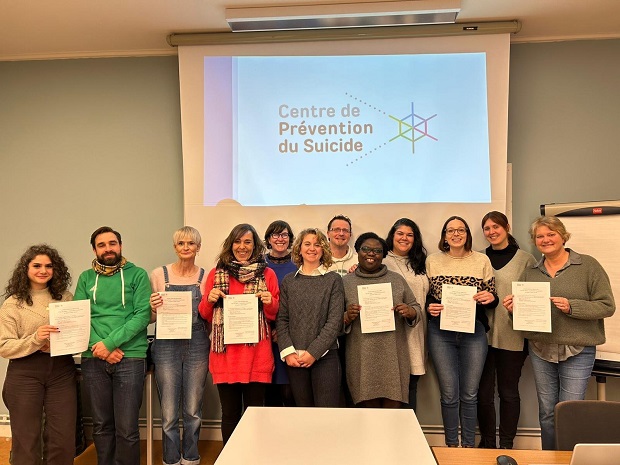
The French-language Centre de Prévention du Suicide intervenes before, during and after a person takes their own life. It provides consultations for people in crisis situations and those bereaved by suicide, as well as training and awareness campaigns. The service also runs a 24/7 suicide prevention hotline, which answered 25,000 calls in 2025.
Worryingly, it has experienced a rise in young people calling the line and requesting help, says director Dominique Nothomb. “The lockdown, and the psychological isolation that occurred, has had a deep impact on young people,” she says, pointing out the disturbance of their social and academic lives at a crucial period in their personal development.
“Successive crises, each bringing its own form of anxiety: eco-anxiety related to climate change, wars, financial crises, inflation, a labour market in crisis, etc. If adults worry about the future, young people do as well.”
The common message in the centre’s interactions with youngsters is that they do not want to talk to their families about the struggles they’re facing because they don’t want to be a “burden”; they don’t want to add more pain or worry to their loved ones.
“No one chooses to suffer. It’s not their fault,” she says, adding that it’s important to speak out, whether it be about depression or bullying at school or online. “Talking to a trusted adult or a professional is essential.”
What is the centre’s advice for families who are worried about a loved one? “Create an environment in which respectful and friendly discussions can take place,” she says. “Don’t judge, exaggerate or minimise. Listen to them with kindness. Don’t hesitate to ask if they are feeling suicidal.”
Nothomb says it’s a common misconception that talking about the subject with a young person could trigger a suicidal act. “This is not the case. What it does is send the message that you are here to listen, that you care, and that the topic can be addressed.”
Families need to be prepared to hear all kinds of answers when asking if someone is feeling suicidal, she adds. “If the answer is yes, stay calm and talk about the available resources. With young people in particular, you can take the step of reaching out for help together.”
Talking about suicide is part of the centre’s community outreach services, in training for schools, organisations and businesses, explains Nothomb. “It is also important to take care of a community after a suicidal act occurs. It’s important to remind people that asking for help is normal.”
The centre equally sounds the alarm about the difficulty it faces meeting the increasing demand for its services without additional resources.
“It is essential to provide additional funding for existing structures such as ours,” she says. “This has become urgent, particularly at a time when the mental health system in Belgium is overwhelmed, risk factors are increasing and citizens’ mental health is deteriorating.”
Befrienders Worldwide Global Suicide Prevention
Centre de Prévention du Suicide Suicide prevention centre and crisis helpline (Fr)
Community Help Service (CHS) Mental health centre and crisis helpline (Eng)
Darkness into Light - Belgium Awareness-raising and fundraising initiative by Pieta (Ireland’s national charity for suicide & self-harm prevention)
Un pass dans l’impasse Brussels suicide prevention centre (Fr)
VLESP Flemish Centre of Expertise in Suicide Prevention (NL)
1813 Suicide helpline (NL)
For more information on suicide behaviour and mental health services in Belgium: Mental health care in Belgium: National survey plus where to get help and support | The Bulletin
Photos: CHS; Tasiaux family; CHS; Centre de Prévention du Suicide
The production of this feature was supported by a grant from the Local Innovative Media In Europe Network (LIMENet), co-funded by the European Union.