
- Daily & Weekly newsletters
- Buy & download The Bulletin
- Comment on our articles
Related articles
Recent




Popular




New report finds failings in Brussels Metro 3 project
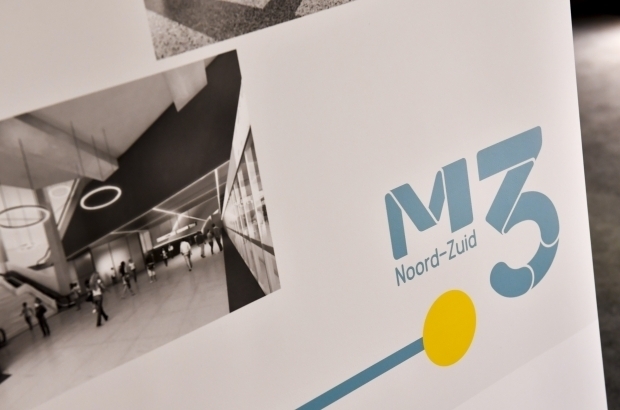
A special committee investigating the handling of Brussels' Metro 3 project has issued its findings and recommendations, concluding that the organisation, financing and planning of the project have proved to be unsuccessful.
“The feasibility of the planned Metro line 3 to the north must be reassessed,” the committee concluded, adding that a thorough review must first be carried out to determine whether it is desirable, technically feasible and financially viable to go ahead and extend the metro network as planned.
The special committee highlighted the complex division of responsibilities between various institutional partners and levels of government for the tumultuous project, Bruzz reports, noting that this made it difficult to make decisions.
It also noted that the Brussels region was unable to fully finance the project from the outset and that the costing methodology, the financing mechanisms and risk management were inadequate.
Technical problems encountered at the Palais du Midi and Brussels-North made it clear to the committee how important it is to better anticipate technical, geotechnical and heritage-related risks.
These risks were not optimally shared between the public authorities and the contractors, the committee said, and the economic, social and urban consequences of the project were underestimated.
The report comes with 22 recommendations divided into various pillars that cover the administrative approach and accountability, the quality of the studies, independence and environmental impacts, technical risks and budgetary feasibility, the legal framework and funding, the local impact and the conditions for the completion of the Metro 3 project.
One of the recommendations is to appoint a single steering body in the future for every infrastructure project of "major regional importance" to bear responsibility and take decisions. This body must have a project director who is accountable to the government and parliament and must ensure coherence, swift decision-making and overall control of the project.
Studies into infrastructure projects must also include the most unfavourable scenarios in the cost benchmark, which serve as an objective yardstick for comparing the expenditure with that of industry peers.
“The research must always take the most unfavourable scenarios into account,” the committee said.
Studies into the infrastructure works must also take greater account of the impact on heritage and the city before any structural decisions are taken.
Under the "local impact" pillar, the committee recommended that requests for amendments from local stakeholders - such as associations, traders and local residents - should no longer be dealt with on an ad hoc basis during the public inquiry, but rather during a formal consultation phase. All requests for amendments will have to be submitted within a specified timeframe during that phase and will then be assessed in their entirety.
The committee also advocates a single central point of contact for local residents and traders affected by the economic consequences of the works, and said the legal framework must be amended to mitigate the impact on local stakeholders.
It also concluded that the feasibility of the planned metro line 3 extension to the north must be reassessed. In particular, it is calling for a thorough review to determine whether it is desirable, technically feasible and financially viable to extend the metro network before a decision is taken on this matter.
“Before work begins, a compensation scheme must be drawn up that offers financial certainty,” the committee writes.
In May this year, local shopkeepers were still asking for support. The committee pointed out that several businesses had gone bankrupt or moved out of the affected neighbourhoods.
Regarding the continuation of the works, the committee recommends proceeding with the works for the tram line on the southern section, as set out in the regional policy statement.
However, it points out that “at the same time, the technical possibility of converting the tram line into a metro line at a later date must be safeguarded, should this be technically and financially feasible”.
The committee’s findings will be discussed in the Brussels parliament on 17 July.