
- Daily & Weekly newsletters
- Buy & download The Bulletin
- Comment on our articles
Related articles
Recent





Popular





“Expat Brat”: Growing up American in Brussels — A family, a city, and an era of change

In this first of a two-part essay, David Simpson reflects on growing up as an American child in Brussels during the transformative decades of the 1960s and 1970s. Part One explores the rise of the postwar expatriate community, the schools that shaped a generation, and the surprising cultural influences — from classrooms to comic books — that quietly forged identity abroad. Next week, Part Two will examine the social world of the American expat “bubble,” its tensions with the wider Belgian society, and the gradual ending of an era that was truly one-of-a kind.
When my father, Ted Simpson, an advertising executive from St Louis, Missouri, was sent to Brussels by his firm in July 1965, our family had no idea we were about to become part of something much bigger than our own household adventure.
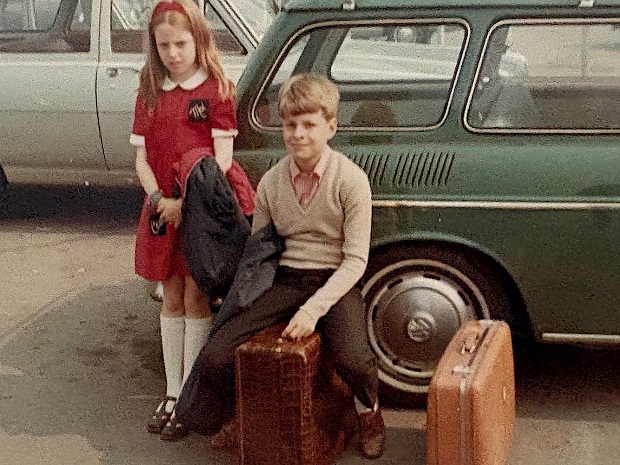
My mother Sally, sister Marnie (6), and I (8) joined him just as Europe was still rising not far from the long shadow of World War II — and Brussels, as a city and crossroads of commerce and diplomacy, was at the center of it all.
For the next 13 years, we called Brussels our home. It was an era — and a city — defined by economic recovery, exploding cross-continental business networks, a swelling population of American expatriates (“expats”), and the complex crosscurrents of culture, politics, and identity that followed in the wake of my country’s expanding global footprint.
American business and expat life in postwar Europe
In the 1960s and 1970s, Brussels was not just a Belgian capital — it was beginning to be recognized as the capital of Europe. Its location mattered. Situated on the old North Sea trade routes and, crucially, home to major European institutions, the city became a hub for multinational corporations eager to tap into the emerging Common Market, now known as the EU. Brussels drew diplomats, bureaucrats, military personnel, and business executives from the United States and across the globe.
While firm statistics from that era are scarce, today’s official count of Americans residing in Brussels is in the low thousands, a small share of the city’s nearly 1.3 million residents. During the 1960s–1970s, the US expatriate community was much more prominent in daily life than the raw figures suggest — thanks to corporates, NATO and US Department of Defense (DoD) personnel, and their families — even though exact census-style counts aren’t readily available. American business interests were installing themselves at every turn, and with them came families — spouses, children, new routines, and networks that resembled home far more than the unfamiliar streets of the European capital. Cars, generous housing allowances, tuition-paid schooling: expat packages with all the “perks” were the freight that kept families like ours moving overseas.
The schools that raised us all

For children of expats — including my sister and me — school was an early anchor of community life. The International School of Brussels (then the American School of Brussels) had been founded in 1951 to educate the children of DoD personnel and civilian workers, and by the mid-1960s had grown to encompass elementary and eventually high school education in an international setting. A third school, St John’s International School, was founded in Brussels in 1964 and later relocated to Waterloo in 1973, further reflecting the steady expansion of the expatriate community and its institutions.
In 1967, the US DoD built its own Brussels Elementary High School for military families, part of a network of DoDEA schools serving service members’ children tuition-free.
Outside those three pillars, many American kids — including my sister and me — attended local Belgian or international schools such as École Hamaide, Le Verseau out near Wavre, the École Decroly, or even the Lycée Français, where academic rigor and multilingual immersion prepped us for a more global future. In those classrooms, distinctions between nationality faded as quickly as the languages within their walls blended—“Have you seen my cahier?”; “Where’s my cartable?”; Would you like to borrow my stylo?”
Learning languages and enjoying activities in multinational environment
But if I am honest about how many of us really learned French, it was not solely through grammar drills or dictées. It was through Belgium’s beloved comic books — the bandes dessinées, or simply “BDs,” as they are universally known. Week after week, my sister, our friends and I devoured them, rushing to the local newsstand whenever a new issue appeared. We absorbed vocabulary, humor, slang, and cultural nuance from the adventures of Tintin, the antics of Spirou, the hapless brilliance of Gaston Lagaffe, the gentle mischief of Boule et Bill, the blue-skinned world of Les Schtroumpfs, and the laconic swagger of Lucky Luke. These stories were not just entertainment; they were our informal language lab. Long before we understood verb tenses formally, we understood punchlines. Long before classroom fluency arrived, we could follow plots, jokes, and wordplay.
Many of these “BD” characters and books endure to this day, fixtures of Belgian cultural identity and still beloved by both old and new generations of readers. For us, though, they were more than comic heroes — they were teachers.
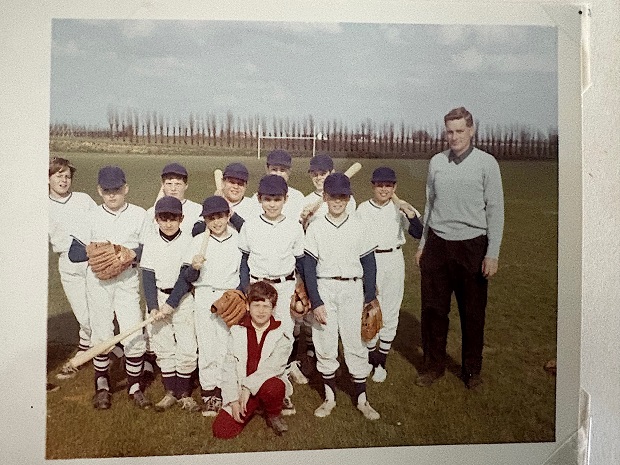
Beyond academics, sports and youth culture cemented friendships and rivalries. Our international schools fielded teams in soccer, basketball, volleyball, and other sports — all mostly funded by American businesses, multinational corporations, and the generous expat packages that covered uniforms, equipment, and travel. Saturday afternoons often brought American football games, with the ISB Raiders facing the Brussels Brigands, drawing fans from across the expat and local communities. Baseball? Check! We fielded teams in Little League, Big League and Senior League—again, all funded by the American business community, on fields which they built. Their logos appeared on our uniforms, eg Caterpillar, Texaco, ITT, Monsanto, P&G, Corning, Phillips Petroleum and many, many more.

Scouts programs — both Boy Scouts and Girl Scouts — flourished as well. Sponsored by expat families and local chapters, they offered yet another layer of social life, adventure, and civic education. Summer camps, community service projects, and cross-cultural activities gave children and teenagers the chance to explore, lead, and belong.
These were not merely extracurricular activities; they were at the foundation and formation of our young lives abroad. Between classrooms that blended languages, comic books that sharpened our French, and playing fields sponsored by American corporations, we were being formed in ways we scarcely understood at the time. We were Americans, yes — but also something slightly more complicated: children of a city that was itself learning how to be international. We were truly multinational in every sense of the word!
David Simpson lives in New Jersey, just outside New York City. After his formative years in Brussels, he attended Washington University in St Louis and went on to a 35-year career in marketing communications. Through McFarland & Company, he will soon publish 'Beyond the Landing Zone — Memoir of an 82nd Airborne Glider Soldier in WWII', an expanded edition of his father’s personal wartime memoir.
Photos: The Simpson family, 1966, Rhode-St-Genèse; Marnie and David leave for Summer Camp, 1966; ISB and St John's school students waiting for buses on first day of school, Fall 1965; Little League at DOD, Spring 1969 (David Simpson far left); US Girl Scouts Brownies 1965 at ISB; all photos ©David Simpson