
- Daily & Weekly newsletters
- Buy & download The Bulletin
- Comment on our articles
Related articles
Recent



Popular




Saint-Gilles residents protest against rising drugs violence

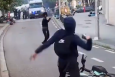
About 500 residents of the Brussels municipality of Saint-Gilles have held a protest against the rise of drugs-related violence in the neighbourhhood, calling on authorities to prioritise prevention over repression.
“Organised crime has created a hellish machine in our neighbourhoods, fuelled by drug trafficking,” said Timothy Eden, one of the organisers.
“This machine is engulfing our streets, our parks, our playgrounds, but also our shops and restaurants. We feel abandoned by our elected representatives, who seem to be concerned only with political manoeuvring.”
Marcella Militello of the non-profit organisation BASTA! (Belgian Antimafia: Steps Toward Awareness) emphasised that solutions must be community-based.
“Law enforcement is part of it, and the police and the judiciary must have the necessary staff and resources, but they cannot solve this problem on their own. The solution must also come from residents and civil society,” Militello said.
“That’s why we don’t need an army of soldiers, but an army of teachers, social workers and outreach workers.
"We must also be prepared to welcome into our community young people who have fallen into the trap of organised crime and are coming out of prison or a youth detention centre, and offer them new prospects."
Militello noted that young people, and in particular unaccompanied minor asylum seekers, must be given special attention, as they were easy prey for criminal organisations that see them as cheap and easily replaceable labour.
BASTA! also campaigns for better support for local businesses and for funds seized during criminal operations to be invested in neighbourhoods.
The outcry against violence in the neighbourhood has only increased following a recent series of drugs-related shootings.
“Those shootings are just the tip of the iceberg. In upper Saint-Gilles, they’re having to deal with burglaries, and in the lower part of the neighbourhood, social problems manifest themselves in the form of drug use and litter,” said one resident, who has lived in the municipality for 37 years.
“In terms of violence, it has never been as bad as it is now. We need more solidarity between the 19 municipalities. In Uccle, the arrival of a reception centre for asylum-seekers caused a huge scandal. But it cannot always be the same municipalities that organise the reception.”
Eden also echoed concerns about other types of crime in Saint-Gilles.
“There have already been at least 50 burglaries this summer, and in many of the cases, the resident was actually at home,” Eden said.
“On average, it took the police 83 minutes to arrive on the scene following an emergency call. This is totally unacceptable, but hardly surprising. We’ve heard from the Midi police zone that there are only six patrols on duty at night covering the entire area. I get the feeling that many government ministers have tacitly accepted that this neighbourhood is being overrun by crime.”
Militello and protestors pointed to the social reforms of the federal government as part of the problem, noting that these have increased pressure on local authorities.
“Brussels municipalities now have to choose between extra funding for the police or extra support for food aid for the CPASs (social welfare centres), which are under pressure,” said Militello.
“We always see the interior minister responding, but where is the health minister in relation to the addiction epidemic? Where are our education ministers with ideas to keep young people out of the clutches of drug gangs?
"It’s nice that some ministers have come here, but really they should spend a night here, to know what it’s like to hear a shooting taking place just a few metres from your door."
Brussels public prosecutor Julien Moinil echoed the protestors’ concerns at a recent press conference he held, saying that “anyone can become a victim” and that “the public is at risk”.
Moinil has held press conferences in the past regarding his concerns about gun violence in Brussels during the summer months. He did so in August last year as well, following shootings mainly in Molenbeek. Six months before that, the press were also called in following the shootings at Clemenceau metro station in Anderlecht.
“Since that press conference, 150 shootings have taken place in Brussels. I am therefore going to be repeating myself, as the phenomenon has not abated,” Moinil said in his most recent remarks.
“There’s a constant sense of urgency, but I’ve noticed that the shootings come in waves, with several incidents now occurring in quick succession once again. The shootings are linked to the drug trade, but that’s nothing new. A cycle of retaliatory attacks is currently under way.”
Moinil drew attention to the fact that innocent civilians have been caught up in the drugs-related violence, citing two examples from just this year alone.
The public prosecutor said the judicial system is facing all manner of shortcomings, to which an adequate political response has yet to materialise, even though he has raised various issues on several occasions.
For instance, Moinil has been requesting signal jammers for over a year, designed to block mobile phone signals in prisons because contract killings are regularly plotted from within prisons.
“The justice system is useless if gang leaders can order someone’s death from prison,” Moinil said. “I don’t understand why my request is being ignored.”
Moinil also highlighted the issue of undocumented migrants, drawing a distinction between those without a criminal record and those who have committed criminal offences.
He referred to a police report showing that 90% of the 7,000 undocumented migrants apprehended by the Brussels police in 2025 were released.
“It’s nothing short of a disgrace; it highlights the weakness of the state,” said Moinil.
“We have suspects who’ve already been issued with five to 10 orders to leave the country. These people are an easy source of labour for the gangs. We should not be welcoming towards someone who is residing here illegally and selling cocaine.”
Like BASTA!, Moinil also noted that criminal gangs also make extensive use of minors - not only Belgians and undocumented migrants, but also young people of French nationality from the north of France and the region around Marseille, who are recruited via social media by “the lure of money and alliances between Belgian and French gangs”.
In Brussels, young people regularly appear before the juvenile court in cases involving drug-related crime, but their sentences often cannot be enforced immediately. There are still 150 young people on the waiting list for a place in a secure institution, a backlog that has persisted for some time.
“We also see that 95% of young adults involved in shootings already had a record with the public prosecutor’s office when they were minors,” said Moinil.
“We can win this war by responding swiftly. The more investigators we have, the faster we’ll make progress.
"I’m repeating myself after last year, but I hope that stepping up the fight against drug-related crime will now proceed at a faster pace than the renovation of the facade of the Justice Palace."
Brussels mayor Philippe Close also expressed frustration with the situation in the capital, pointing to the port of Antwerp as the cause for the recent surge of violence.
“The drugs don’t just parachute in here - why aren’t they taking more action in Antwerp?” he asked, singling out Antwerp representatives in the federal government, including prime minister Bart De Wever (N-VA).
“Rotterdam is doing everything it can to stamp out drug trafficking. They’ve really cracked down there. As a result, the cocaine market has shifted to Antwerp.
"I understand that the Antwerp port economy is fundamental to our country, but you get the feeling that the prime minister and perhaps also his entourage want to spare the port of Antwerp."
Belgium’s interior minister Bernard Quintin (MR) responded to criticisms by saying authorities were “actively looking for detectives, but you do need to find the right people”, and he referred to the increasing violence as “a national emergency”.
“Every level of government must take targeted measures wherever possible in this war on drugs, which we absolutely must not lose,” Quintin said.
An operation last week mobilised a total of 450 police officers, about 70 military personnel and some 100 security officers from Brussels’ public transport operator Stib.
The operation had been planned for some time but was brought forward following the recent and intense wave of drug-related violence in Saint-Gilles, Anderlecht and Molenbeek.
“This is the largest operation since the launch of the Major Cities Plan a year and a half ago,” said a spokesperson for Quintin, noting that while dealers and people residing in the country illegally were the primary targets, in principle the operation was aimed at all forms of crime, both major and minor.
This is the first time that military personnel have also been deployed in the field for such operations.
“We want to make it clear that criminals and drug dealers are not in charge here,” said defence minister Theo Francken (N-VA).
Quintin said he would spend the coming days and weeks pressing for more funding from the federal government to fight organised crime.
“But it’s about more than just resources. We need to install more CCTV cameras as quickly as possible and make the registration of electric scooters compulsory,” he told Bruzz, referencing the fact that e-scooters have often been used as getaway vehicles during drug-related crimes.
“Prevention and the health effects of drug use also deserve greater attention. And local authorities must make full use of their powers to close down businesses or impose bans on public gatherings. It’s a long-term battle, but we absolutely must not lose it.”