
- Daily & Weekly newsletters
- Buy & download The Bulletin
- Comment on our articles
Related articles
Recent





Popular





Several Brussels schools and creches close at lunchtime due to extreme heat
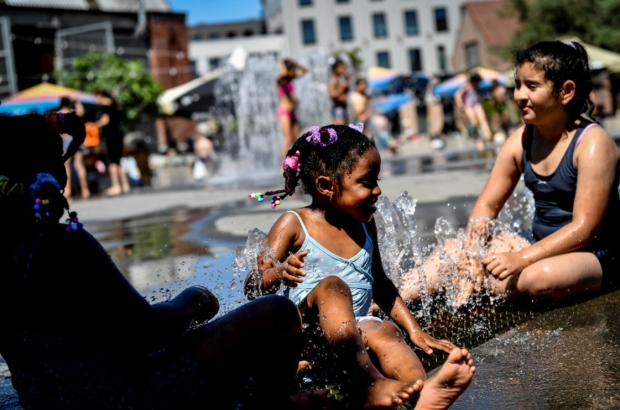
A number of schools and daycare facilities in Brussels have opted to close at lunchtime due to the extreme heat.
Temperatures of up to 38°C are expected in Brussels until and including Friday, and an orange alert for heat throughout the whole of Belgium is in effect.
“The conditions are not suitable for teaching in the best possible way,” Etterbeek’s mayor Vincent De Wolf (MR) said, explaining why his council decided to take "exceptional measures" and suspend all lessons from Monday 22 June through to Friday 26 June.
Exams scheduled for the morning will go ahead as planned.
Parents are being asked to collect their children and emergency childcare is provided on site for those unable to do so, with water games and activities in the shade.
At Etterbeek's five municipal creches, parents have been asked to keep their children at home, with “care still provided for families who need it”.
It is not only Etterbeek where such measures are being taken. In about half of the 13 nurseries run by the Dutch-speaking Sint-Goedele school group around the Brussels region, childcare will exceptionally finish at 15.30 all week instead of 17.00 or 18.00.
“This only applies to nurseries without air conditioning. In nurseries that are sufficiently cooled, normal childcare will continue,” said managing director Bruno De Lille.
“It all depends on the specific building. The same applies to our schools. We’re now working with the school management teams to see whether we can accommodate pupils in cool classrooms or even outdoors, should that be necessary.”
The 32 nurseries run by the Dutch-speaking GO! Brussels school group are open as usual, although a heatwave plan is in place and headteachers can still decide to close.
“At the moment, we recommend seeking out cooler places, for example by taking the class to a park,” said spokeswoman Karin Struys.
Anderlecht is also taking steps to adapt to the heatwave, allowing parents to keep their children at home or collect them at lunch should they choose to. Provided the school is notified in advance, these pupils’ absences will be considered authorised.
Similar actions are also being taken in a number of Walloon municipalities, in particular in Hainaut and Namur province, where many schools are closing at midday with on-site supervision of children as needed.
Meanwhile, GP practices and the Brussels fire brigade are issuing their own heat warnings and advising residents to drink plenty of fluids, avoid physical exertion and stay indoors during the hottest hours of the day.
“Extreme heat can quickly lead to dehydration, exhaustion or heatstroke, sometimes with serious consequences,” said Walter Derieuw of the Brussels fire brigade.
“During a heatwave, a simple gesture can save a life. A phone call to an elderly relative, a visit to a neighbour living alone, or offering a glass of water to someone who is struggling can prevent a situation from escalating into a medical emergency.”
The fire service reminded the public that swimming in the Brussels canal is strictly prohibited, even during heatwaves.
Care homes are also enforcing a heatwave plan, which includes, for example, having a cool room in every care home and ensuring every resident stays sufficiently hydrated.
For vulnerable and elderly residents who still live at home, various local authorities across municipalities are already opening cool rooms.
Koekelberg’s air-conditioned room is located at the Jourdan Village care home (Rue François Delcoigne 39) and a shuttle service can be booked. Etterbeek residents can find air-conditioning in the entrance to the town hall, as well as a drinking fountain.
The Félix Hap garden and the Fontenay-sous-Bois gardens, both in Etterbeek, will remain open until 21.00 (instead of 18.30) as a special measure.
The heatwave in Belgium is set to continue this week and will only intensify over the coming days.
The Royal Meteorological Institute (RMI) is forecasting maximum temperatures of more than 35°C in most places, except along the coast, where a yellow alert remains in force.
Under the orange alert in effect everywhere else, authorities suggest measures such as drinking regularly, dressing more lightly, spending the day in cooler rooms, monitoring your health regularly, eating easily digestible food and keeping doors and windows closed.
Night-time temperatures will also remain exceptionally high and forecasts suggest the tropical heat will persist even beyond Saturday, with the RMI predicting maximum temperatures above 30°C on Sunday.
Belgium has been experiencing an exceptionally early heatwave since Wednesday 17 June. Only in 1922, 1947, 1998, 2006 and 2023 did heatwaves begin earlier than this year.
Since records began, 51 heatwaves have been recorded, but only 16 of these began before 1 July. The historical benchmark remains the heatwave from 22 June to 8 July 1976, with 15 consecutive days on which the temperature exceeded 30°C. Only the 2019 heatwave was more intense, but it lasted considerably less time.
This year could see the highest daily temperature ever recorded in June in Uccle. If the forecast temperature of 37°C is reached on Thursday, it will break the record of 36.8°C recorded on 27 June 1947.
The high night-time temperatures over the coming days will raise the average even further. A "warm night" is a night on which the minimum temperature does not fall below 15°C.
Since Tuesday 16 June, seven warm nights have already been recorded and, according to current forecasts, the minimum temperature will remain above this threshold until the end of the month.
“The impact of the heatwave on people and nature is further exacerbated by the fact that the night brings hardly any relief from the heat,” the RMI said.
“Although such records are meteorologically remarkable, they’re not good news. Early and intense heatwaves increase the pressure on public health, water availability and the natural environment, and heighten the risk of drought and heat stress.
"Furthermore, the fact that a heatwave of this magnitude is occurring as early as June is consistent with the trend of increasingly frequent and extreme heat peaks observed in Belgium over recent decades."