

- Daily & Weekly newsletters
- Buy & download The Bulletin
- Comment on our articles
Related articles
Recent




Popular





“Macho culture” among causes of Wetteren train crash
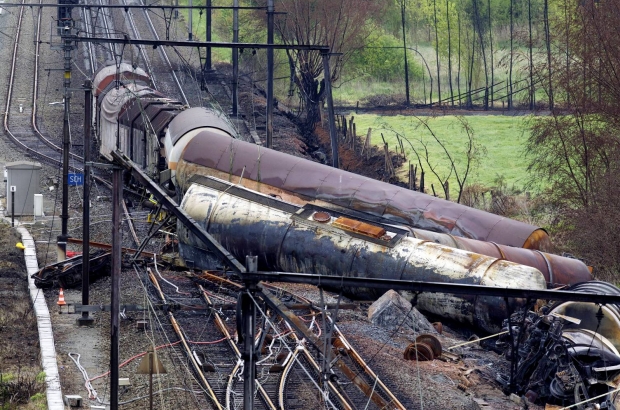
The train crash at Wetteren, East Flanders, in May of 2013, which led to toxic chemicals being leaked into the environment, the death of one person and the evacuation of 2,000 homes, was partly caused by a “macho culture” that prevents drivers from admitting to fatigue, according to a report from the OOIS, the body that investigates incidents on the railways.
On May 4 last year, a goods train derailed near Wetteren. Seven of the 18 wagons derailed, and three leaked the toxic chemical acrylonitrile. One resident in the immediate area died in the following hours from toxic fumes. Others were forced to leave their homes, in some cases for weeks.
The accident happened when the train ran through an S-bend at 84kph, where a limit of 40kph was imposed. The driver said he had seen a warning signal, but took no evasive action.
The report points to the “extremely likely effect of driver fatigue on the origin of the accident” and recommends the introduction of a security management system for fatigue risks, such as is used by various companies in the aviation sector.
“It appears from our talks that, in practice, drivers very seldom report a high degree of fatigue,” the report says. “This is mainly due to the professional culture of the job. Thanks to that culture, described by many drivers as ‘macho’, you’re not allowed to admit that you’re tired because that’s an indication that you’re in some way weak. In that context, it seems inappropriate to allow the matter of judgement and management of fatigue to be one for the driver alone.”
The accident cost an estimated €13 million, the report says, with environmental damage costing €3.8 million, and infrastructure costs reaching €3.3 million. Fire service costs were €1 million, but the costs of police, civil protection services and the collection of soil and water samples have not yet been counted.





Comments
Just recently somebody told me that UK trains were "dangerous" and "terribly expensive".
She has never used one.
A recent study showed the UK has among the safest trains in the World and despite the tales of terrible expense, can be far cheaper that mainland fares out of the peak period.
Shocking I know.
Mikak13 --- Trains and railways in Britain are no better or worse than anywhere else. . And so do many people. With or without a survey (to be the right one this time, of course). Shocking, I know...
Don't be daft, ACS. UK trains are better than some and worse than others, but the point is the general impression given over here is that it will be a life threatening experience and the expense will be eye watering.
It's just not so, though some services at certain times are certainly not cheap it's because the people using the trains are the ones paying for them. It was just a very a very amusing report to read, particularly as the researcher had set out to prove that UK trains were expensive and unreliable compared to the mainland, and even he was stunned by his own findings.
Crowded? Certain services certainly are, but then one has to ask why they are so popular if terribly expensive and unreliable?
@Mikak -- "Daft"? Alas, now the whole country knows. I also know one thing: one day, during a railway strike in Belgium, and having explained to the station-master the last train was my only means to get home, they had a small engine take me there, no questions asked. It was good enough for me...Particularly they were neither rude or insulting about it, in other words they knew their railway code!