

- Daily & Weekly newsletters
- Buy & download The Bulletin
- Comment on our articles
Related articles
Recent




Popular



'Our parks have become event venues': Nature advocacy groups against plans for Osseghem Park light festival
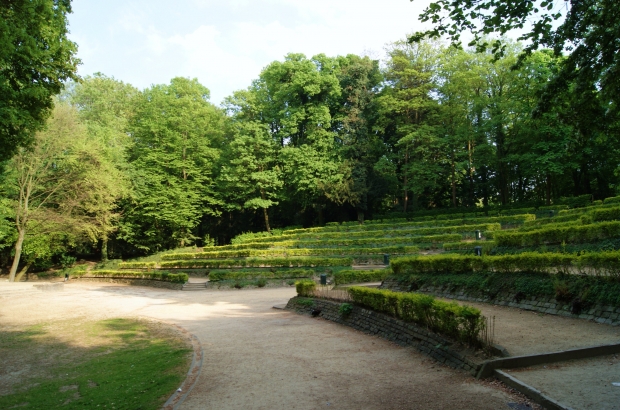
The City of Brussels is seeking an operator for a light trail in Osseghem Park during the winter months, but experts are warning about damage to nature and the long-term privatisation of parks in general.
The city is looking to make a regular new attraction in the park near the Atomium, describing their vision as an "immersive" and "family-friendly" light festival designed to guide visitors along a trail through the park from mid-October to early January.
Such light festivals, often accompanied by music, have been in vogue for several years now. The nearby Meise Botanical Garden hosted a light trail last winter.
But Ann Voets, art historian and landscape architect, warns that such light trails are damaging to nature.
“A light trail like this places a very heavy burden on the park. If nature cannot recover during the winter, we’ll see the harmful consequences there after a few years,” Voets told Bruzz, noting that the city failed to conduct a preliminary study to identify which areas should never be accessible, so as to allow certain animal species to sleep undisturbed.
“Bats hunt nocturnal animals, but a light trail can disrupt the day-night rhythm of their prey. The bats will then be unable to find food.
"Brussels already scores abysmally in terms of light pollution. That’s why renature.brussels, the plan drawn up by Brussels Environment, advocates limiting it. How can this initiative be reconciled with that?"
Ossegem Park is already under heavy strain in the summer due to Couleur Café, resulting in wear and tear on the grassy areas and disturbance to wildlife.
“For a light trail, an operator will undoubtedly choose the most attractive spots in the park, such as the avenue and the Théâtre de Verdure,” said Voets.
“The same parts of the park will thus be put under strain again, and for almost three months. The tender specifications also don’t mention a maximum number of visitors.”
Another point of criticism is the privatisation and commercialisation of public space, which affects Brussels on a larger scale.
VUB researcher Jozef Vandermeulen of the Cosmopolis Centre for Urban Research criticised the policy of Brussels mayor Philippe Close (PS) in a recent opinion piece, saying this increase in public-private partnerships has mixed social consequences: a financial benefit for the private operator and both advantages and disadvantages for the public partner.
“In this case, the city council’s aim is quite transparent: a temporary privatisation of a public park to bolster revenue and boost tourism, but this comes at the expense of a park that will not be accessible free of charge for three months and whose ecological balance will be further disrupted,” Vandermeulen told Bruzz.
“My feeling, based on the announcement, is that things are swinging far too far in the direction of private interests here. The scale of the closure, the final ticket prices and who will run the operation could still make a difference.
"If the operation were to be run by a non-profit organisation that reinvests the profits in the park’s biodiversity, I’d be able to take a much more positive view."
Voets also sees a pattern, particularly with regard to the parks: “Just recently, we had a DJ set in Bois de la Cambre, the American-themed party in Cinquantenaire Park and the football fan villages in Wolvendael Park.
"Our parks, which should be protected because of their cooling effects in a warming climate, have become event venues. There are plenty of buildings and water features at the Heysel. Why not create a light trail there?”
The call for tenders for the new light trail closed last week. The concession is renewable twice and may therefore be valid for three editions.
It is not yet clear how many fully qualified candidates there are, but Brussels alderman for green spaces Florence Frelinx (MR) said that the administration was currently assessing which applications meet all the criteria.
The operator will have full access to the entire park for the operation of the trail and may also install ticket offices, demountable food stalls and temporary toilets. The trail’s opening hours will be restricted to a maximum of four days a week, from 17.00 to 22.00.
The city is hoping to profit from the event by collecting 10% of the gross revenue from admission fees and a fixed annual lump sum from the operator.
But Voets said that this was nothing more than “putting on a show, because with 10% of ticket revenue, you can at best repair the damage caused”.
Frelinx said that the event will be crafted in such a way to minimise the impact on nature.
“The installations must be fully reversible, non-invasive and designed in such a way that their impact on fauna (birds, bats, amphibians), flora (trees, undergrowth, vulnerable soils) and the landscape is kept to a minimum,” the city council stipulated in the tender specifications.
Frelinx wrote on social media the aim is to “upgrade Osseghem Park without compromising its character, offering a high-quality experience, while at the same time protecting nature and the living environment of local residents.”





Comments
In this age of climate change, turning parks, forests – in short, nature – into event venues should be a no-go