
- Daily & Weekly newsletters
- Buy & download The Bulletin
- Comment on our articles
Related articles
Recent



Popular




Sheep complete 160km procession to Brussels
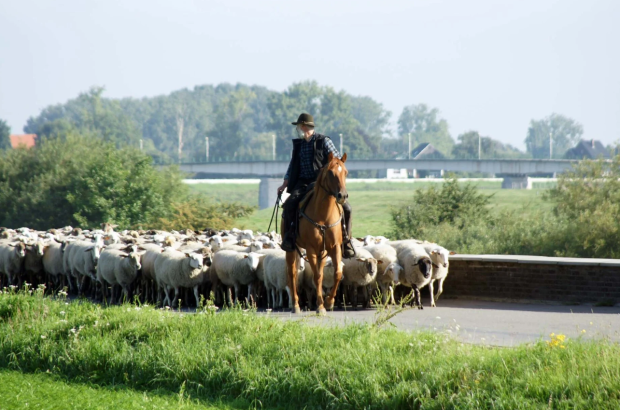
About 350 sheep are travelling from Limburg province to Brussels’ Bois de la Cambre as part of an awareness-raising effort from shepherds regarding their endangered profession.
The Belgian procession - 160km long over 16 straight days - is part of a wider movement, Bruzz reports.
Limburg farmers Toon and Johan Schouteden hope to use the walk to emphasise the value of sheep for landscape management and raise the issue that there are currently too many rules and regulations having a negative impact on shepherds.
Among these, they say, are that the area where sheep are allowed to graze is limited, shepherds receive too little support and grazing contracts are too short. In general, every other year or every three years, local authorities review who is allowed to graze where.
They also point out that the number of small-scale abattoirs has dwindled, leaving them nowhere in Limburg to process their mutton, and say protective measures for wolves have increased the threat of these animals when it comes to flocks.
Brussels city shepherd David Dhondt echoed the Limburg farmers’ concerns, saying that although there was an abattoir in Anderlecht, he prefers small-scale slaughter that necessitates travelling all the way to Kluisbergen in East Flanders.
“That takes me an enormous amount of time,” Dhondt said, adding that grazing space is also a concern of his.
“The only thing we don’t have to worry about, thanks to all the buildings, is the wolf.”
The Flemish Sheep Farmers’ Association, co-organiser of the shepherds’ walk, hopes for greater attention and support for the survival of rare sheep breeds.
Antwerp shepherd Maarten D’hondt was invited to speak about local wool at the launch of the walk. Such wool is often dismissed as second-rate, and the wool of Brussels’ rare black-faced sheep is worth even less because it is coloured.
The city shepherd, together with the non-profit organisation La Lainerie and Schaerbeek-based designer Pauline Dornat, is setting up projects to revalue the fibre.
The shepherding profession as a whole is under pressure worldwide, which is why the United Nations declared this year the Year of Pastoralists and Grasslands.
Vétérinaires Sans Frontières (Vets Without Borders) will hold a symposium on the subject as part of the Bois de la Cambre protest.
The Shepherds’ Walk to Brussels began in Hamont-Achel at a rather quick pace.
“At the start of a trek, sheep reach speeds of 6km/h,” Toon Schouteden said.
“As soon as they realise they’ve got a longer trek ahead of them, they slow down again.”
Every day, the flock sets off for 10-12 kilometres. Their distance is limited by terrain. While sheep can easily manage natural earth or soft paths, the tarmac sometimes causes them trouble.
Each afternoon, the flock takes a break of at least two hours.
“They have to; they hardly eat whilst on the move,” said Loupa Pius, a shepherd from Uganda who joined the trek at the invitation of the NGO Vets Without Borders.
Members of the public are welcome to walk along with the sheep and can use a tracker to check exactly where the flock is at any given time.
On Sunday, the flock made a stop at the Africa Museum in Tervuren. From there it will head into the Brussels region on Monday via Auderghem, making its way to Watermael-Boitsfort along the Sonian Forest.
On Tuesday 13 October, the final day, the flock will arrive at Bois de la Cambre at midday. Shepherds from all over Europe will be in attendance, including a Spanish choir consisting entirely of shepherds.
In previous walks, shepherds set off with their flocks from Berlin and the Dutch Wadden Sea island of Texel. In a relay-style journey, different flocks take turns. Some sheep only join the march for a single day.