
- Daily & Weekly newsletters
- Buy & download The Bulletin
- Comment on our articles
Related articles
Recent



Popular

Solar eclipse 2026: Don’t miss the summer celestial experience on 12 August

Belgium is getting ready to experience the best solar eclipse since 1999, with citizens scrambling to secure the special sunglasses needed to view the rare celestial event.
The country, like most of Europe, will be plunged into darkness on the evening of 12 August as the Moon begins to slowly slide in front of the Sun from 19.18.
One hour later, the Sun will be almost completely covered with 90% obscurity. By 21.05, the phenomenon will be over.
Although Europe’s next total solar eclipse is in 2027 and a partial eclipse in 2028, stargazers will have to wait until 2081 for one of the same magnitude.
To experience the upcoming impressive partial solar eclipse you need to be equipped with special sunglasses and have a clear view of the setting sun to the west.
Looking directly at the sun even for a few seconds risks causing permanent damage to your eyes. Normal sunglasses or 3D cinema specs do not suffice. Although most opticians and supermarkets have sold out their eclipse glasses, some stores have managed to restock. Otherwise, welding glasses are a safe alternative if shade 14 or higher.
Where to see the eclipse?
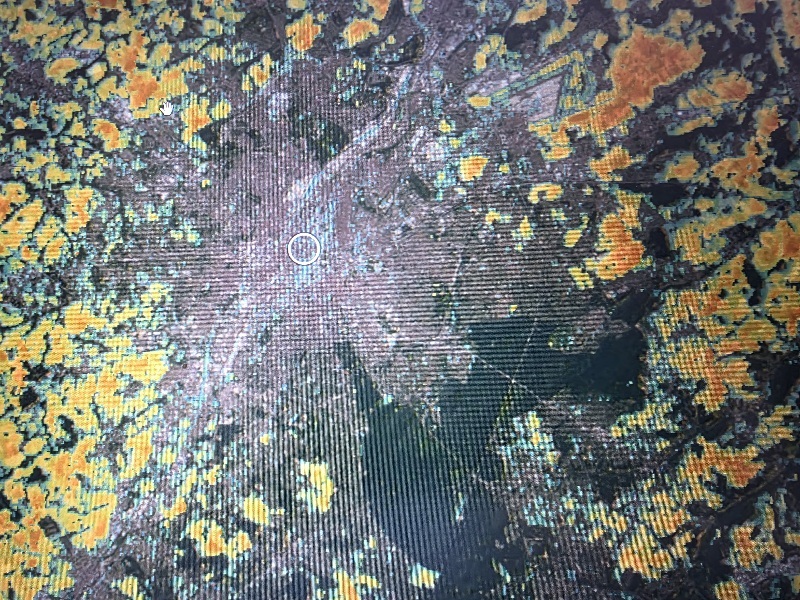
For an unobscured view of the partial eclipse in the capital, it is best to head to the outskirts of the city. For the occasion, Koekelberg Basilica is exceptionally opening its panorama on Wednesday evening at 18.45. Reservations via telephone 02.421.16.60 or by email: info@basilicakoekelberg.be. Entrance: €8 per person.
Although Saint-Gilles cemetery offers a clear view of the setting sun, it closes at 16.00, with stargazers expected ti gather in nearby Rue du Bourdon. Another option is the Zavelenberg nature reserve in Berchem-Sainte-Agathe. From Avenue Charles Quint, take the dirt track to the sheep enclosure for an unobscured view of the phenomenon.
Otherwise, the Treflerie urban farm in Woluwe-Saint-Pierre invites visitors to view the eclipse from the highest point of its grounds.
“[The Farm] is a collective agroecological project, bringing together market gardening, cut flowers, a plant nursery, beekeeping and a sensory garden,” it told RTBF.
“[The public] is welcome to observe the eclipse from the top of the property (at the top of the path along the sheep fence) as long as the cultivated areas of this private land are respected,” added the garden.
In the surrounding Flemish Brabant region, there are numerous recommended viewing spots. They include Paalvedstraat and Borgtveldweg in Grimbergen and paths and cycle tracks in Asse, as well as places in Overijse and Sint-Pieters-Leeuw.
The Sunset Atlas website (pictured above) is a good reference point as it indicates areas – in red and yellow – where the setting sun can be best observed.
Other celestial happenings
The night sky is already offering an unusual celestial show, RTBF reports. Emmanuel Jehin, astrophysicist at the University of Liège, said: “Six planets are visible in the sky in the morning and late at night, particularly before sunrise.”
But only three are visible to the naked eye: “Jupiter very low on the eastern horizon, just before sunrise at 5.30; Saturn to the south; and between the two, the easily recognisable reddish planet of Mars. Uranus and Neptune require telescopes to see. And Mercury, with a pair of binoculars, you might be able to spot it just above Jupiter,” he added.
Another highlight this month is the Perseids summer meteor shower. It traditionally peaks on the night of 12 to 13 August. Astrological conditions for the stunning luminous trail are particularly favourable this year, commented Jehin.
“The absence of moonlight will allow for a full viewing experience. If the weather remains favourable, it will be possible to observe between 20 and 30 shooting stars per hour,” he said.
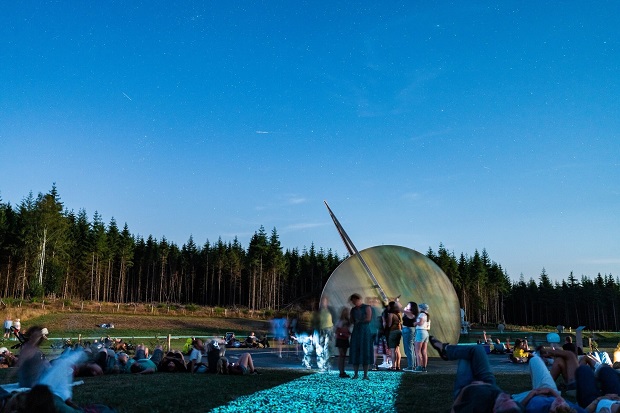
The Euro Space Center in Transinnes, Luxembourg Province, organises its annual Night of the Stars on 13 August (pictured above).
Its free event from 16.30 offers a programme for all the family with scientific and creative workshops, storytelling and planetarium sessions accompanied by commentary explaining the constellation activities in the sky above.
Photos: ©Euro Space Center; screenshot Sunset Atlas