
- Daily & Weekly newsletters
- Buy & download The Bulletin
- Comment on our articles
Related articles
Recent

Popular



Soldiers back on the streets for at least three months
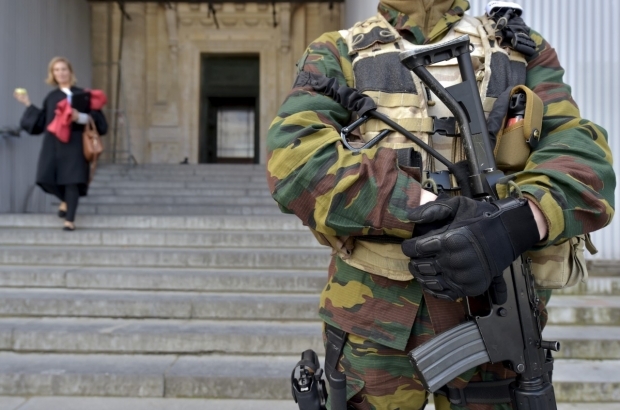
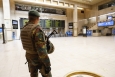
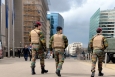
About 100 soldiers from the Belgian army are patrolling the streets of Brussels and Antwerp for at least three months, along with Liège where a synagogue was recently attacked.
The aim is to boost security around Jewish sites, which have seen an increase in threats since the war in Iran.
If the three-month period is extended, the number of troops deployed will be scaled back, according to defence minister Theo Francken (N-VA).
Initially there was talk of a maximum of 200 soldiers for the whole country, but that figure has now been reduced to about 100, as confirmed by both Francken and interior minister Bernard Quintin (MR).
Both ministers were unwilling to disclose how many of the soldiers will be patrolling in Brussels, but according to sources, there are at least 17 locations in the capital receiving a military guard, including two Jewish schools and the Jewish Museum on Rue des Minimes, where four people were killed in a terrorist attack in 2014.
“For obvious reasons, no details are being released,” the ministers said.
While the patrol areas primarily concern Jewish schools and synagogues, in Brussels, the Israeli embassy in Uccle is also said to be among the locations where military personnel will be stationed.
The last time Belgian soldiers patrolled the streets was during Operation Vigilant Guardian in 2015 after the attacks on the Charlie Hebdo editorial office in Paris. That operation ended in mid-2021, after more than six years of patrolling.
The operation at the time began with about 150 military personnel, but the number quickly rose to several hundred.
Following the Paris attacks in November 2015 and the Brussels attacks in March 2016, those numbers were significantly increased. At the height of the operation, more than 1,800 Belgian soldiers took part in the mission.
Just as during Operation Vigilant Guardian, there is no legal framework to give the army greater powers.
“In principle, they’re only allowed to do what civilians are allowed to do,” criminologist Sofie De Kimpe (VUB) told Bruzz.
“If they catch someone in the act, they may detain them, but they must immediately call the police. Shooting is only permitted in cases of lawful self-defence.”
While a draft text that sets out what soldiers are permitted to do - such as conducting searches and identity checks - is ready, Francken said it could take several months to come into force.
The lack of a legal framework is the source of much criticism, including from Natasja Gaytant of the army union ACOD Defence.
“Suppose a soldier on patrol is attacked and strikes back with the butt of his rifle, resulting in a broken nose,” Gaytant said.
“What if that person files a complaint with the police for assault and battery? How far does legal self-defence extend in that case? Then we’re off on a legal tangent. If people with malicious intent realise this, it becomes dangerous.”
Both Gaytant and De Kimpe say the presence of soldiers offers little added value, not even as a deterrent.
“There were also soldiers on duty in Brussels Airport at the time of the attacks in 2016,” said De Kimpe.
“We have absolutely no right to detain people or check their identity. You might as well just put an inflatable soldier there.”
Separate from patrols to protect Jewish sites, the federal government also approved a motion last week to deploy 45 soldiers in Brussels for joint patrols with the railway police in metro and train stations
These military personnel could also be deployed in large-scale operations against drug-related crime as early as next month.