
- Daily & Weekly newsletters
- Buy & download The Bulletin
- Comment on our articles
Related articles
Recent




Popular



Women’s Day focus: Fighting the good fight
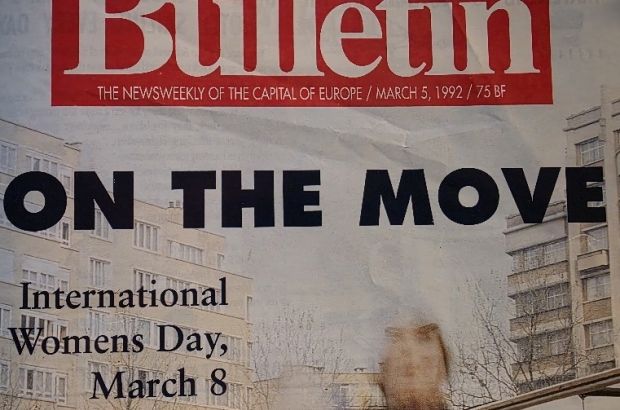
On the eve of International Women’s day on 8 March, The Bulletin reflects not only on the achievements of women’s rights over the past 150 years, but also the ongoing fight for fair representation.
While rightly recognising the victories that were scored, it is also a moment to highlight the ongoing challenges. From unequal pay, racial injustice and gender-based violence to inadequate healthcare and disproportionate caregiver responsibilities, discrimination persists.
Casting an eye through The Bulletin’s archives, a copy of the weekly magazine dated 5 March 1992 jumps out. A series of articles by the editorial team outlined the progress achieved by activist groups over previous decades.
Recalling the heady days of militant and collective action in the 1970s, one feature described the momentous event of 11 November 1972, when on a rare occasion both Flemings and Francophones came together for the first national women’s day.

Two women who transformed the feminist movement, Australian activist Germaine Greer and French existentialist Simone de Beauvoir, addressed a gathering of more than 8,000 women packed into the Passage 44 in the centre of Brussels. “Homemade rag dolls carrying mops and brooms were hung around the auditorium to symbolize the domestic plight of women,” wrote Rosamond Green.
This collective outcry followed a period in which women began to exercise their voice. In 1966, some 3,000 female workers at a steel factory in Herstal, near Liège, went on strike over unequal pay. It led to the founding of a feminist group, A travail égal, salaire égal, which continued to campaign afterwards on a number of social issues.
In Flanders, the group Dolle Mina, was one of a number of women’s organisations to spring up. It achieved notoriety in 1969 when some of its members employed by a bank in Antwerp protested over their banned from smoking at work. The rule did not apply to their male colleagues.
The 1970s was also a period marked by campaigns against the antiquated abortion laws. Buses were laid on to transport women to the Netherlands, where abortion was legal. A first women’s house was inaugurated in Saint-Josse and attention turned to supporting battered women, who had previously been ignored.

Expat women were active in the cause. American Lydia Horton was behind the International Tribunal on Crimes against Women staged in Brussels in 1976. It was attended by women from some 30 different countries and they discussed issues from medical abuse and legal and economic inequities to physical violence and social discrimination.
Economic recession in the 1980s may have dinted feminist activity, but another strike in Wallonia revived its spirit. Women workers at the Bekaert-Cockerill factory in 1982 had to fight to retain their right to work after management and trade unions agreed that the 30 female members of staff had to cut their working hours or half of them would be made redundant. The women went on strike and the 13 most outspoken were sacked; their jobs given to male colleagues. Although the case went before an industrial tribunal, the women were not reinstated, only compensated with six months of pay.
In the ensuing period, individual achievements replaced collective action. Women’s focus In the 1990s was principally reconciling their professional aspirations with raising a family.
Since then, the workplace has remained a focus for feminist activism, even if it is more individualistic. From the persistent pay disparity to the lack of representation in senior management positions and the often ongoing juggling of domestic duties, female representation continues to lag behind.
What happened to the all-female Crew research centre?

Another article in the issue was dedicated to Crew, the Centre for research for European Women, under the title Out of the home, into the Community. Originally an independent women’s cooperative founded in 1980, it turned into a 12-strong all-women team of professional researchers, writers and artists who specialised in women’s issues on a European level.
The group was set up by non-Belgian women who came to Brussels for professional reasons. In 1992, Rebecca Franceskides was the sole remaining founder involved in the organisation. A lawyer, with a master’s degree from the LSE in the UK, she arrived in the capital on a Belgian government fellowship to research European Community law and the issue of male-female equality at ULB.
Noticing along with other women the information gap in Brussels at a European Community level, they set up a magazine which published in English and French. It provided monthly reports that succinctly and without jargon summed up the issues discussed in the institutions that affected women, whether on social policy, employment or the budget. “The people we work with like the way we pick up information and take it a step further,” Franceskides told Rosamond Green in 1992.
The research centre helped create the European Network of Women in 1983, which acted as a watchdog for women’s rights. It also helped women set up their own business, it created Brussels first women only training Centre offering business and computing skills and worked with training organisations throughout the EU to develop gender sensitive training content and delivery.
“Crew lasted another eight years before it closed its doors,” says the former lawyer and journalist. “I felt that it had done its job. By that time, the women’s movement had become a lot more mainstream (within the EU institutions anyway).”
Franceskides recounts how the last years of Crew focused more on what was then called personal development and on how women in management could find their own voice instead of trying to copy men. They also worked with journalists, “to understand how every story can and could include the experience of women in society without this being the subject of the story,” she adds.
Now working with clients on self realisation and empowerment through meditation, energetic healing and physical movement, she feels like her career has been “a natural progression from the political to the personal as a force of change”.
Asked about how she believes women’s representation has evolved, she responds: “Although younger women may be grateful or even aware of the changes thar resulted from the women’s movement in the 1980s and 1990s, there is also a feeling that there is more pressure now on women to succeed both as mothers and in their careers and some are opting out. So more diversity on the way forward is good.”
Reflecting on her previous commitments, Franceskides says: “I did what I did when I was young because I felt there was a deep injustice in the world. There has been progress and transformation since then but also many more subtle layers of discrimination remain, and new ones evolve.”