

- Daily & Weekly newsletters
- Buy & download The Bulletin
- Comment on our articles
Related articles
Recent




Popular


How the Schuman roundabout lost its way

Guest post by Stavros Papagianneas, author of Rebranding Europe (2024), Embracing Chaos (2021) and managing director of STP Communications, which often shot video for its YouTube channel from the beleaguered roundabout and now misses its maligned but former appearance.
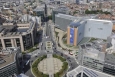
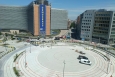
The redesign of the Schuman roundabout has been presented by the City of Brussels as a transformation from a traffic-dominated junction into a welcoming public space: complete with a central pedestrian agora, new landscaping and the aim of creating a place for events and social interaction.
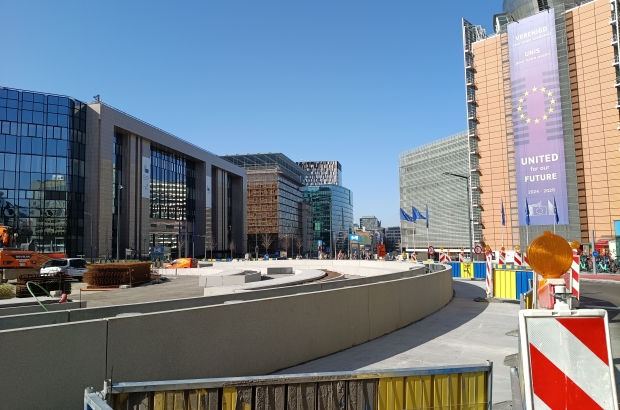
While these objectives may appear attractive in principle, the new roundabout illustrates there are substantial arguments that the previous configuration served the area more effectively - and that the redevelopment illustrates broader governance and implementation challenges in the city. Aesthetically, it now has the look of a giant upturned saucer.

When an international competition selected a Belgian-Danish consortium of architects to redesign the space, it was promised an “urban agora” with a steel canopy and green roof as its centrepiece.
This canopy was to be the crowning glory. Planners imagined EU workers and local people would meet and socialise under the shelter, modelled on the European Parliament’s distinctive hemicycle.
However, it was never built. By the time works began in 2023, six years after the winning design had been chosen, costs had spiralled due to inflation and the Brussels government's own financial woes.
One of the strongest criticisms, especially in the wake of successive heatwaves this summer, concerns the loss of mature vegetation. The former Schuman roundabout contained numerous established trees that provided shade, reduced urban heat, improved air quality and softened the otherwise “monumental” character of the European Quarter.
Maturer trees not only provide an attractive backdrop in a city dominated by concrete buildings, but also deliver ecological benefits that newly planted saplings cannot immediately replace.

Concrete, the cornerstone of modern infrastructure, comes at a steep environmental price. Its production is a significant contributor to greenhouse gas emissions, consumes vast amounts of natural resources and poses threats to ecosystems through habitat destruction and water pollution.
It often takes several decades before replacement trees provide comparable cover, carbon storage, biodiversity and cooling effects. As a result, the area risks becoming significantly less comfortable during warmer months despite promises of future greening.
The previous layout also reflected Schuman's functional reality as one of Brussels' principal transport hubs. Every day, thousands of pedestrians, buses, taxis, and vehicles converge at this intersection.
The Schuman roundabout efficiently managed traffic flow in several directions and was familiar to users who had grown accustomed to its layout.
The concept appears driven more by symbolic urban planning than by the actual needs of the neighbourhood. The European Quarter is characterised by office buildings whose occupancy fluctuates significantly throughout the day
The creation of a large central plaza produces an underused space rather than the vibrant civic gathering place envisioned by planners, undermining commercial and social activities in the neighbourhood.
The project has also become emblematic of Brussels' complex institutional landscape. Responsibility for planning, mobility, public space, utilities, and infrastructure is divided among multiple levels of government and public agencies.
Coordinating these actors frequently results in lengthy delays, repeated redesigns, escalating costs, and prolonged disruption for residents, commuters and businesses. While major infrastructure projects inevitably involve complexity, the Schuman redevelopment has reinforced public perceptions that fragmented governance can hinder efficient project delivery and accountability.
Construction itself has imposed years of inconvenience. Extended roadworks, changing traffic patterns, noise, dust, and restricted access have affected daily life and economic activity in the area.
Critics contend that the eventual outcome does not clearly justify these prolonged disruptions, particularly given the ongoing debate over whether the redesign significantly improves the junction's functioning.
Even if talks are afoot to “green” the roundabout and a petition has been launched to restore the original plan for a canopy, this project shows how big urban design ideas can sometimes conflict with the real challenges of running the city, protecting the environment and meeting the daily needs of citizens.





Comments
It was a very nice roundabout before all this stupidity. Haven't Brussels City ever heard the adage: if it ain't broke, don't fix it!!!! Now it is the ugliest thing in creation.
"If it ain't broke, don't fix it" should apply to all ongoing construction projects in Brussels. The adage "Change is like a vacation" doesn't hold true here. All construction sites in Brussels are a real nuisance, and the situation is often worse than before, as is the case here.