
- Daily & Weekly newsletters
- Buy & download The Bulletin
- Comment on our articles
Related articles
Recent




Popular


Family of assassinated Congolese leader Patrice Lumumba seek truth, justice and reparation in Brussels
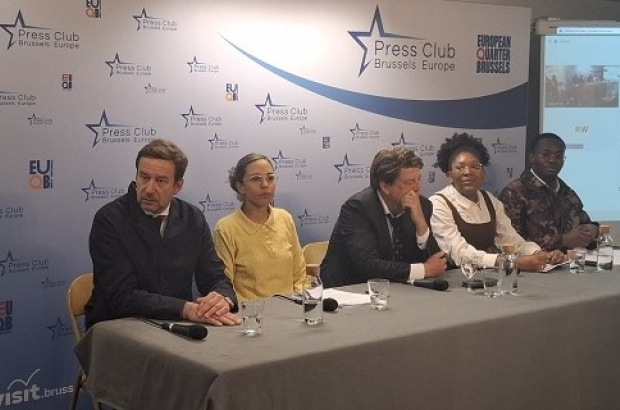
The family of Patrice Lumumba, along with their lawyers, called for truth and justice over his assassination in 1961 at a press conference following a closed court hearing in Brussels.
Focusing on whether 93-year-old Belgian ex-European commissioner and businessman Etienne Davignon could face war crime charges, the Brussels Court of First Instance is examining if there are sufficient elements and charges for Davignon to be prosecuted in front of a criminal court. It is expected to deliver its decision on 17 March.
The former public official is the last known Belgian alleged to be implicated in the plot to assassinate the first prime minister of the newly independent Republic of Congo (now Democratic Republic of Congo), a former Belgian colony.
Belgium’s federal prosecutor’s office suspects Davignon, a diplomat trainee when Congo became independent in 1960, to have been involved in the arrest, illicit detention and transfer of Lumumba, as well as his humiliating and degrading treatment.
Following a coup led by Joseph Mobutu in September 1960, Lumumba was first arrested then transported to Katanga where he was assassinated in mysterious circumstances.
As a rich mining province, the then secessionist state of Katanga was led by pro-Western leader Moïse Tshombé, a political opponent of Lumumba, who had the support of the Belgian government and its mining company, Mining Unions of Upper-Katanga.
Lumumba was assassinated on 17 January 1961, along with his political allies Maurice Mpolo and Joseph Okito. His body was then dissolved in sulfuric acid, leaving no trace of his remains with the exception of a golden tooth.
The tooth, which had supposedly been taken at the time by a Belgian police officer, was seized by Belgian justice in 2016 and officially restored to Lumumba’s family by the Belgian government in 2022.
“What made it possible to open this process of justice and reparation was the parliamentary commission that was set up by the Belgian parliament back in 2001,” Christophe Marchand, lawyer to the Lumumba family, told the press conference.
“This parliamentary commission has shown a certain democratic vitality as it was the parliament, the representation of the nation, that independently decided to delve into the kingdom’s archives to dig out all the elements,” he added.
Following this commission, the Belgian government admitted in 2002 to having a moral responsibility in the plot leading to the assassination.
François Lumumba, the son of Patrice Lumumba, filed the first complaint in 2011. It had to be considered a war crime assassination, recognised in international law, rather than a common law assassination for which the statute of limitation had expired, explained Marchand.
“It was necessary to demonstrate that it was an act of aggression by one state, Belgium, against another sovereign state, the Congo,” he added.
The Brussels Appeal Court upheld the argument on 12 December 2012 by stating that the facts could be considered as war crimes, according to Marchand.
Today, around 10 family members of Lumumba are involved in the case as civil parties. Last week's court hearing was also symbolic as it marked the passing of the torch to the new generation which is composed of his grandchildren.
“Since 2011, we refrained from questioning the integrity of the judicial institution, and we have not engaged in any form of excess regarding the procedure. Why? Because despite the injustices and violence perpetrated against his people, Patrice Lumumba firmly believed in the law as a compass for relations between individuals and peoples,” stated Mehdi Lumumba, one of Lumumba’s grandchildren.
“Yet, since his execution, the law has failed to live up to Patrice Lumumba’s expectations. We therefore expect it to finally do so,” he added.
“We are seeking legal truth. Beyond reparations, there is also this desire to heal wounds that are not only wounds of the Lumumba family. They are also wounds of the entire Congo,” said Yema Lumumba, his granddaughter.
Davignon denies that Belgian authorities were involvement in the leader’s assassination.